
Terracotta is not just a material. It is the legacy of a thousand-year-old tradition, of craftsmanship and of a deep relationship between people and nature. Every planter, vase or garden container carries a story – the story of clay, fire and the hands that gave it shape.
You may have wondered why some terracotta pots last for decades while others start to crack after just a few winters. The answer lies not only in the material itself but above all in how it is made. The production method has a decisive influence not just on appearance, but above all on the function, durability and lifespan of the finished product.
In this article we guide you through the individual production techniques – from traditional handwork to industrial manufacturing. We show you their strengths and weaknesses and help you understand why genuine Tuscan terracotta from Impruneta is the best in its field.
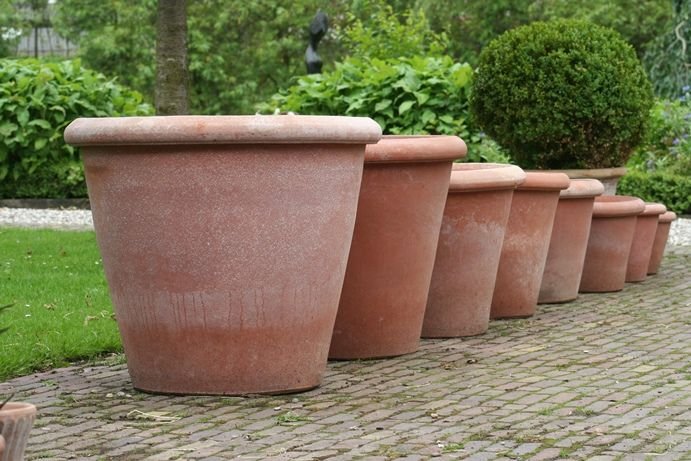
1. The Colombino technique – the art of handwork
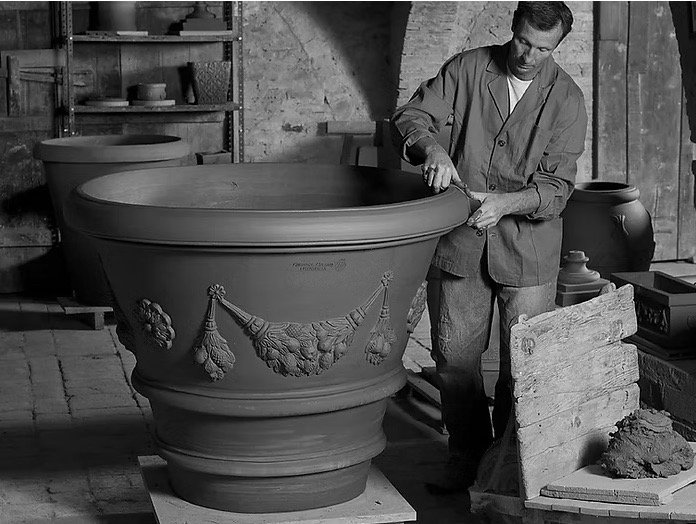
The Colombino technique is one of the oldest and most prestigious ways of making terracotta. Each piece is built up by gradually layering and modelling the clay without any moulds. The craftsman works with the material directly – feeling its texture, moisture and resistance.
The result is absolute originality. No two pieces are identical. Every vessel has its own character, subtle variations and details that make it a unique object.
This process is time-consuming and requires deep experience. That is exactly why Colombino is associated with luxury, exclusivity and the highest quality.
ADVANTAGES +
- Every piece is an original
- Maximum quality of workmanship
- High aesthetic value
- Can be individually customised
DISADVANTAGES –
- Higher price
- Long production time
2. Hand-pressing into plaster moulds
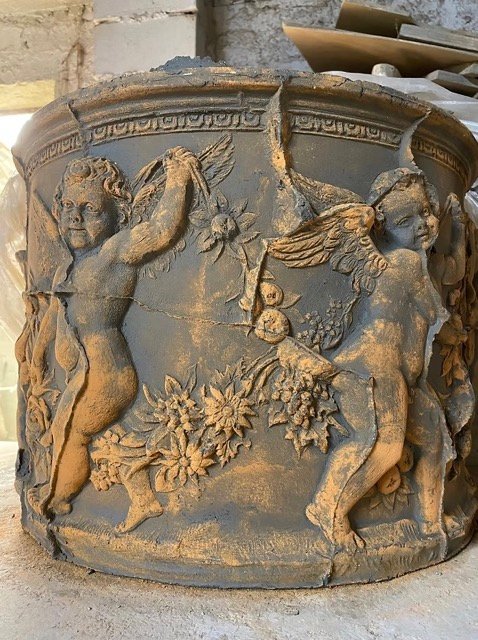
This method is a compromise between handwork and efficiency. The clay is pressed into plaster moulds, which gradually absorb the moisture and allow a firm shape to form.
Each mould can be reused, which makes production more efficient. Even so, the products keep a degree of originality, especially thanks to the details being finished by hand.
The resulting products are high-quality, aesthetically balanced and suitable for a wide range of uses – from private gardens to architectural projects.
ADVANTAGES +
- More efficient production
- Consistent quality
- More complex shapes possible
- More affordable than fully handmade pieces
DISADVANTAGES –
- Less originality in individual pieces
- Moulds wear over time
3. Plaster mould and lathe
Another technique used in both traditional and semi-traditional production combines a plaster mould with a lathe. This method is suited above all to round vessels where high precision, regular curves and uniform wall thickness are wanted. The mould is placed on a rotating base and a special tool is used to form the vessel’s inner profile.
Aesthetically, this method can deliver a very clean, harmonious result. The vessels look balanced, smooth and technically precise. External decorations, however, are usually finished by hand at a later stage, so there is still room for the craftsman’s touch.
Compared with purely handmade production, this method is faster and more predictable, but it limits freedom of form. It is ideal for collections where elegant repeatability and visual clarity are wanted, but it is not suitable for every type of vessel.
ADVANTAGES +
- Very regular, balanced shape
- Very clean aesthetic result
- Faster production than purely handmade work
- A good solution for larger runs of round vessels
DISADVANTAGES –
- Only suitable for round shapes
- Less originality
- Limited scope for individual shaping
4. Automated machines with plaster moulds
With this technique, making products is much faster and simpler to organise. The machines are semi-automatic or fully automatic, and the clay is placed in the mould so that the machine itself does most of the forming and releases the finished shape. Human input comes mainly at the finishing stage.
For producing larger quantities of vessels, this is a very efficient system. It allows similar pieces to be made repeatedly in a relatively short time while keeping production parameters stable. The advantages of such products are usually a lower price and the ability to meet higher demand quickly.
At the same time, automation brings certain limits. The final product can look less lively, less distinctive and at times less authentic than a vessel made under the constant eye of an experienced craftsman.
ADVANTAGES +
- Lower price
- Suitable for larger production runs
- Higher production speed
- Fairly good aesthetic level when properly finished
DISADVANTAGES –
- Not every shape that can be made by hand is possible
- The final product can look less distinctive
- Fewer customisation options
- Not unique pieces, but repeated machine production
5. Pressing machines with metal moulds
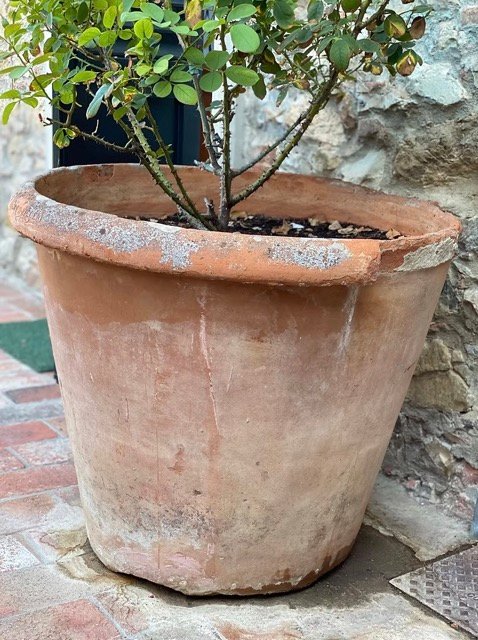
Pressing machines with metal moulds are the most industrial form of production. The process is built on high speed, repeatability and maximum efficiency. The mould is made of metal, and a denser clay and release agents are often used to separate the vessel from the mould.
Commercially, this method has undeniable advantages: it is cheap, fast and suited to high-volume series production. At first glance the product can also look very smooth and technically perfect.
This is often where the crucial difference lies between cheap production and truly high-quality terracotta. The combination of dense clay, machine pressing and a fast cycle can impair the vessel’s mechanical strength, natural breathability and long-term durability, particularly against frost and moisture.
Products made this way may show signs of surface flaking, fine cracks or loss of material cohesion within the first years of use. A smooth, polished look does not always mean real quality.
ADVANTAGES +
- Very low price
- Suitable for series production
- Increased production speed
- Smooth surface typical of industrial production
DISADVANTAGES –
- Lower frost resistance
- Simpler, less distinctive shapes
- Often lower aesthetic and craft value
- Virtually no personalisation options
Why the production method really matters
At first glance two vessels may look alike. They can have a similar shape, a similar colour and a comparable size. Yet there can be a fundamental difference between them. It often shows only over time – after the first winter, after a few seasons on the terrace or after long exposure to rain, frost and sun.
The quality of terracotta is not determined by the clay alone. Just as important is how the material is handled throughout the whole process: how long it dries, how it is fired, whether it has enough time to stabilise and whether the piece was finished with a craftsman’s care. All of this affects its strength, breathability and resistance to the weather.
That is precisely why luxury Impruneta terracotta stands apart from ordinary production – not only in its looks but above all in its technical quality, lifespan and ability to age gracefully. With a quality piece, time does not become an enemy but part of its beauty.
What this means when choosing a planter
Choosing a garden container is not just about design. It is also about whether you are looking for something temporary or a piece that will be a natural part of your space for many years. Handmade terracotta is the choice for those who value authenticity, lasting worth and a character that cannot be mass-produced.
Machine-made planters may be suitable for projects where price or quick availability matters most. But anyone looking for an exceptional object with soul, craft integrity and real durability will sooner or later appreciate the difference between an industrial product and genuine Tuscan terracotta.
Quick summary
- Colombino – the highest craft value, originality and exclusivity
- Handwork with plaster moulds – a very good balance of quality and efficiency
- Lathe – precision and elegance for round shapes
- Automated plaster moulds – faster production, lower price, less originality
- Metal press moulds – industrial production focused on volume, not long-term quality
If you want to discover terracotta that is not only beautiful but also stands the test of time, explore our collection:
Impruneta terracotta plantersFrequently asked questions
Which terracotta production method gives the highest quality?
The handmade Colombino technique is considered the most valuable and prestigious. Each piece is made individually without moulds, allowing maximum control over the shape, the thickness of the material and the final look. It is time-consuming, but that is exactly what gives it the highest craft quality and uniqueness.
Why are handmade planters more expensive?
Handmade terracotta requires more time, experience and personal attention from the craftsman. Each piece is individually worked, carefully dried, finished and checked. The higher price therefore reflects not just the material but above all the quality of the work, the originality and the long lifespan of the finished product.
Is machine-made terracotta less durable?
Not always, but very often, yes. Industrial production usually focuses on speed and low costs, which can affect the density of the material, the way it dries and the quality of the firing. The result can be vessels that are cheaper but less resistant to frost, moisture or mechanical stress.
How can you recognise a quality terracotta planter?
You can recognise a quality terracotta planter by the strength of the material, its balanced shape, natural surface and overall impression of craftsmanship. Resistance to outdoor conditions and the material’s ability to handle moisture naturally also matter. With luxury Impruneta terracotta, the quality of the clay and a properly managed firing play a crucial role too.
What is the difference between handmade and industrial production?
Handmade production offers originality, greater control over detail and higher aesthetic value. Industrial production, on the other hand, relies on speed, repeatability and a lower price. While handmade terracotta looks authentic and unique, industrial products tend to be more uniform and often less distinctive.
Does the production method affect frost resistance?
Yes, very much so. Frost resistance depends not only on the material itself but also on how the clay was worked, dried and fired. Thanks to the right production process, quality Impruneta terracotta can withstand very low temperatures, while cheaper industrial products can be considerably more sensitive to frost.
Is it worth investing in handmade terracotta?
If you are looking for lasting value, a high aesthetic standard and a truly authentic material, then yes. Handmade terracotta is not just a garden container but also a decorative piece with craft character that can give a space depth, elegance and timelessness.