
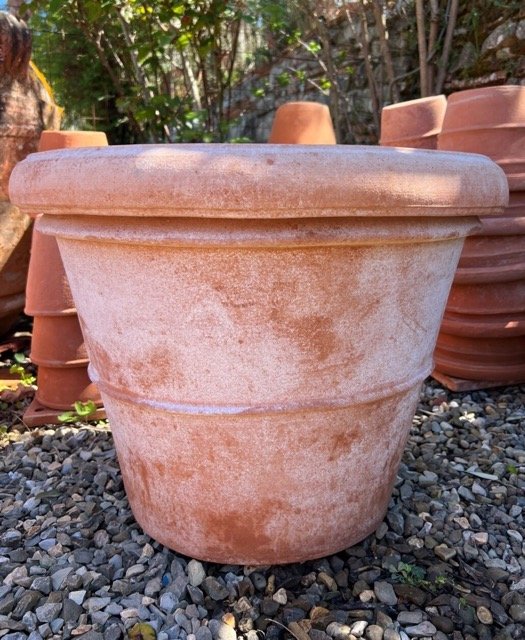
Terracotta pots from Impruneta are a symbol of quality, exceptional durability and centuries of Italian craftsmanship. Thanks to their purely natural composition and high-temperature firing, they protect plants even in very low temperatures while creating an ideal microclimate for a healthy root ball.
Because these vessels are entirely natural and have no sealing glaze, their surface can change in appearance over time. One of the most common things growers notice is a fine white patina forming on the outside of the pot.
Although an inexperienced eye may at first mistake it for mould, it is in fact a completely natural process that actually confirms the high quality and breathability of the material. If you prefer a spotless look, however, we will show you how to restore the pot’s original warm tone easily.
What exactly is the white patina on terracotta?
The white patina, technically called efflorescence, forms when mineral salts are deposited on the outer surface of the pot walls. It is not a fungus, mould or a defect in the material. It consists of crystallised residues of calcium, magnesium and other minerals that occur naturally in soil, in fertilisers and above all in the water you give your plants.
How and why does efflorescence form?
The key to understanding this lies in the very nature of terracotta. Quality terracotta is porous and breathes. It works much like a fine sponge – it absorbs moisture from the watering inside the pot and lets it pass outwards. As the water evaporates through the walls of the pot, it travels to the surface and carries dissolved mineral salts from fertilisers and hard tap water with it.
When the water then evaporates into the air on the outside of the pot, the salts cannot evaporate with it and remain on the surface as a dry, white (sometimes slightly yellowish) coating. Paradoxically, this efflorescence is therefore proof that your pot is working properly, protecting your plant’s roots from rot and dangerous waterlogging.
Does limescale damage the pot or the plant?
Certainly not. Efflorescence has no negative effect on the strength, durability or frost resistance of the pot. Nor does it pose any risk to the plant itself. It is a purely aesthetic matter.
Interestingly, many garden designers and lovers of the Tuscan style actually seek out and value this patina. It gives pots a desirable “vintage”, time-worn look (so-called shabby chic) that makes new containers appear as if they have stood in an Italian garden for generations.
How to clean terracotta pots gently
If you do not like the rustic patina and want a rich orange, clean surface, removing it is surprisingly easy. For everyday care at home we recommend avoiding harsh chemicals and taking the eco-friendly route.
Method 1: Gentle cleaning with vinegar (recommended)
- Prepare a solution of ordinary white vinegar and water (roughly 1 part vinegar to 3–4 parts water).
- Apply the solution to the affected areas with a sponge or spray bottle and leave it to work for a few minutes. The vinegar naturally dissolves the calcium salts.
- Take a stiff brush (not a wire one, so you do not scratch the clay) and clean the surface with circular movements.
- Rinse the pot thoroughly with clean water and let it dry slowly.
Method 2: Using special products
If the deposit is very old and thick (it often forms just above a saucer of water), you may need a stronger product. You can use buffered acids made for cleaning terracotta or very dilute hydrochloric (muriatic) acid. With this method, however, we recommend emptying the pot first, wearing protective gloves and working outdoors. After applying the acid, the pot must be rinsed with water extremely thoroughly so that chemical residues do not later burn the plant’s roots.
Whether you choose to let your pots keep their natural history and patina or keep them spotlessly clean, with Impruneta terracotta you can always be sure you are holding an authentic piece of nature with a unique character.
Wondering which plant suits a pot like this best? Read our guide How to choose the ideal planter for a lemon tree.
Frequently asked questions
Is the white patina on a pot harmful?
Definitely not. It is a natural efflorescence of mineral salts and calcium. It is purely a visual phenomenon with no negative effect on the quality, durability or function of the terracotta pot. This coating on the outside does not harm the plants in any way.
Can white marks be prevented?
With natural terracotta it cannot be prevented entirely, but you can slow the process down considerably. Watering with rainwater helps most (unlike tap water, it contains no calcium or chlorine). It also helps to limit heavy use of liquid commercial fertilisers, which contain large amounts of salts.
How often should I clean terracotta pots?
It depends entirely on your own taste. Many people never clean their pots at all, because the developing patina gives terracotta a historic Tuscan charm. If you prefer a clean look, it is enough to wash the pots at the end of the season before overwintering or in early spring.
Will cleaning with vinegar damage the terracotta?
Ordinary white vinegar diluted with water will not harm quality terracotta. It is a weak acid that safely dissolves the calcium on the surface. The only important thing is not to use steel brushes, which could scratch the clay surface, and always to rinse the pot well with clean water after cleaning.
Will the pot’s original colour change after cleaning?
After cleaning and thorough drying, the pot regains its original warm fired-clay tone. Remember, though, that terracotta absorbs water, so straight after washing the pot will look very dark – it only regains its true shade after a few days of drying in the air.